
(Versão em português abaixo) * (English version bellow)
Grande desafio no caminho espiritual… * A great challenge on the spiritual path…
DEUTSCH
Die vedische Kultur ist so sehr von Spiritualität durchdrungen, dass sie sich im täglichen Leben, in der Musik und in der Literatur offenbart. Spiritualität lauert hinter jeder Ecke, inmitten des chaotischen und nicht konfliktfreien Alltagslebens, das wir in Indien erleben. Das klassische indische Epos Mahabharata ist ein gutes Beispiel dafür. Darin sehen wir die Gegensätze, die den Menschen antreiben. Die Entschlossenheit, den Weg der Selbsterforschung zu beschreiten – das zu tun, was notwendig und richtig ist, um zur Selbsterkenntnis zu gelangen – geht Hand in Hand mit ihrem Gegenteil. Diese beiden Polaritäten mit ihren unterschiedlichen Intensitätsgraden sind in uns und erzeugen Konflikte in uns und um uns herum.
Ich kann nicht umhin, mich an das Gleichnis des Wolfes zu erinnern:
Wir haben zwei verschiedene Wölfe in uns. Der eine steht für Neigungen wie Anhaftung, Besitzdenken, Zorn, Neid, Eifersucht, Gier, Stolz, Groll, Angst, Schuld, Arroganz, Kleinlichkeit und so weiter. Der andere steht für das Gegenteil. Welchen der beiden Wölfe wir füttern, ist eine große Lernherausforderung, die uns das Leben bietet.
Als ich die Audios der brasilianischen Vedanta-Lehrerin Glória Arieira hörte, die das Mahabharata wunderbar erzählt, kamen wir an das Ende des ersten Kapitels. Es endet mit der Begegnung des Kriegers Arjuna und des Avatars Krishna mit dem Weisen Agni, dessen Übersetzung Feuer ist. Das Ende seiner Erzählung bringt eine schöne Lehre, die ich am Ende dieses Textes mit euch teilen werde.
Agni sagt, dass er sehr hungrig ist und dass nur sie seinen Hunger stillen können. Sie bieten ihm an, ihm die Nahrung zu geben, die er braucht. Dann offenbart er, dass er in Wirklichkeit den gesamten dichten, dunklen Khandava-Wald, den sie vor sich sehen, verschlingen muss. Da die Natur des Feuers darin besteht, zu erhitzen, zu verbrennen, können wir verstehen, was mit dem Verschlingen gemeint ist, auf das sich Agni bezieht.
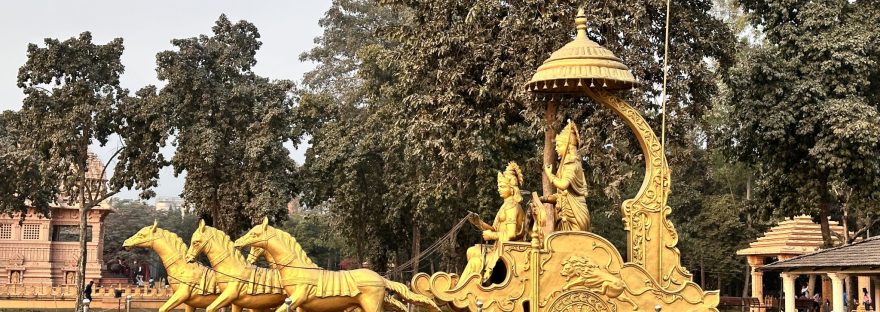
Wie die vedische Tradition vorschreibt, kann die Bitte eines brahman (Priester) nicht abgelehnt werden. Arjuna und Krishna erklären sich daraufhin bereit, die Hindernisse zu beseitigen, die der Tat, dem Verbrennen des Waldes, im Wege stehen, sagen aber, dass sie dazu einen Wagen und die nötigen Waffen benötigen. Und so werden ihnen die Waffen angeboten, die später im Kampf gegen die Kräfte eingesetzt werden, die den Weg zur Selbsterkenntnis unterdrücken.
Mit den Waffen aus der Episode mit Agni besiegen Arjuna und seine Armee unter der Führung Krishnas später die Unterdrückung durch den Tyrannen Duryodhana. Sobald der Krieg vorbei ist, wendet sich Krishna an Arjuna und bittet ihn, aus dem Wagen auszusteigen, der sie während des Krieges gefahren hat. Sobald er aus dem Streitwagen aussteigt, verschwindet es einfach.
Die Vedanta Lehrerin stellt dann eine schöne Parallele zum Leben her, die ich in meinen eigenen Worten und Überlegungen beschreibe:
Die Existenz von allem um uns herum hat eine Dauer, eine Gültigkeit. Alle Werkzeuge, die wir vom Leben erhalten, sind uns gegeben, um uns im Sinne des Selbststudiums und der Selbsterkenntnis zu dienen, mit Respekt und Sorgfalt für alles um uns herum. Unsere spirituelle Entwicklung hängt vom angemessenen Gebrauch dieser Werkzeuge ab, mit der richtigen Einstellung.
Und ich denke wieder an das Gleichnis vom Wolf. Welchen Wolf füttern wir mit den Ressourcen, die uns die Existenz bietet?
Und dann kommt das Ende der Überlegungen. Wenn jedes dieser Mittel, die uns angeboten wurden, seine Funktion erfüllt hat, sind sie dazu verdammt, zu verschwinden, wie der Wagen und die Waffen, die im Krieg gegen Duryodhana verwendet wurden. Wir können hier Parallelen zu Menschen, Gütern, Arbeitsplätzen usw. ziehen. Wie viele Dinge haben wir im Leben verloren? Wie war unsere Einstellung zum Verlust? Oft klammern wir uns an das, was wir einmal hatten, an das, was uns gegeben wurde, und wir bleiben in einer Idee, einer Erinnerung, einer Vergangenheit stecken. Wir erkennen nicht, dass das Leben das Kapitel dreht und dass es an der Zeit ist, sich mit anderen Dingen und Situationen zu verbinden.
*
PORTUGUÊS
UM GRANDE DESAFIO NO CAMINHO ESPIRITUAL…
A cultura védica está tão embebida de espiritualidade, que ela se revela no cotidiano, através das músicas, da literatura. A espiritualidade nos espreita em cada esquina, em meio ao cotidiano caótico e não sem conflitos que presenciamos na Índia. O épico clássico indiano Mahabharata é um grande exemplo disso. Nele vemos as polaridades que movem o ser humano. A determinação em seguir o caminho da auto investigação — daquilo que é necessário e correto ser feito para que possamos seguir no sentido do autoconhecimento – anda, lado a lado, com o seu oposto. Essas duas polaridades, com seus graus de intensidade, estão em nós e geram conflito interno e a nossa volta.
Não posso deixar de lembrar da parábola do lobo:
Nós temos dentro de nós dois lobos diferentes. Um deles representa propensões como apego, possessividade, raiva, inveja, ciúme, ganância, orgulho, ressentimento, medo, culpa, arrogância, mesquinhez e assim por diante. O outro representa o oposto. Qual dos lobos nós vamos alimentar é um grande desafio de aprendizado que a vida nos oferece.
Escutando áudios da professora de Vedanta brasileira Glória Arieira, que narra o Mahabharata lindamente, chegamos ao final do primeiro capítulo. Ele termina com o encontro do guerreiro Arjuna e do avatar Krishna com o sábio Agni, cuja tradução é fogo. E o final da sua narração traz um bonito ensinamento, que eu divido com vocês no final deste texto.
Agni diz que tem muita fome e que só eles podem saciar essa fome que ele sente. Eles se prontificam a dar a ele o alimento que precisa. Ele então revela que, o que de fato precisa é devorar toda a floresta Khandava, densa e escura, que eles veem diante de si. Como a natureza do fogo é aquecer, queimar, podemos entender o que significa o devorar a que Agni se refere.
Como a tradição védica determina, não se pode negar o pedido de um brahmane (sacerdote). Arjuna e Krishna então concordam em eliminar os obstáculos que impedem o feito, a queima da floresta, mas dizem que para isso precisam de um carro e das armas necessárias. E então, a eles são oferecidas as armas que depois serão usadas na luta contra as forças que oprimem o caminho rumo ao autoconhecimento.
Usando as armas do episódio envolvendo Agni, Arjuna e seu exército, guiados por Krishna, vencem mais tarde a opressão do tirano Duryodhana na guerra de Kurukshetra. Assim que a guerra acaba, Krishna vira-se para Arjuna e pede para ele sair do carro que os conduziu durante a guerra. Assim que ele desce do carro, o mesmo simplesmente desaparece.
A professora faz então um bonito paralelo com a vida, que eu descrevo com minhas palavras e reflexões:
A existência de tudo o que há ao nosso redor tem uma duração, uma validade. Todas as ferramentas que recebemos da vida nos são ofertadas para nos servir no sentido do auto estudo e autoconhecimento, com respeito e cuidado a tudo o que nos cerca. A nossa evolução espiritual depende do uso apropriado dessas ferramentas, com a atitude apropriada.
E volto a pensar na parábola do lobo. Que lobo estamos alimentando com os recursos que nos são ofertados pela existência?
E então vem o desfecho da reflexão. Quando cada um desses recursos que nos foram ofertados cumprem a sua função, eles estão fadados a desaparecer, como o carro e as armas usados na guerra de Kurukshetra contra Duryodhana. Nós podemos fazer aqui um paralelo com pessoas, bens, emprego etc. Quantas coisas já não perdemos na vida? Qual foi a nossa atitude diante da perda? Muitas vezes, nós nos apegamos ao que um dia possuímos, que nos foi ofertado, e ficamos presos a uma ideia, uma memória, um passado. Não conseguimos perceber que a vida está virando o capítulo e que é hora de se ligar a outros objetos e situações.
*
ENGLISH
A GREAT CHALLENGE ON THE SPIRITUAL PATH…
Vedic culture is so steeped in spirituality that it reveals itself in everyday life, through music and literature. Spirituality lurks around every corner, in the midst of the chaotic daily life and not without conflict that we witness in India. The classic Indian epic Mahabharata is a great example of this. In it we see the polarities that drive human beings. The determination to follow the path of self-inquiry – of what is necessary and right to be done so that we can move towards self-knowledge – goes hand in hand with its opposite. These two polarities, with their degrees of intensity, are in us and generate conflict within and around us.
I can’t help but remember the parable of the wolf:
We have within us two different wolves. One represents propensities such as attachment, possessiveness, anger, envy, jealousy, greed, pride, resentment, fear, guilt, arrogance, pettiness and so on. The other represents the opposite. Which of the wolves we feed is a great learning challenge that life offers us.
Listening to audios by Brazilian Vedanta teacher Glória Arieira, who narrates the Mahabharata beautifully, we come to the end of the first chapter. It ends with the meeting of the warrior Arjuna and the avatar Krishna with the sage Agni, whose translation is fire. And the end of his narration brings a beautiful teaching, which I’ll share with you at the end of this text.
Agni says that he is very hungry and that only they can satisfy his hunger. They offer to give him the food he needs. He then reveals that what he really needs is to devour the entire dense, dark Khandava forest that they see before them. Since the nature of fire is to heat, to burn, we can understand what is meant by the devouring to which Agni refers.
As the Vedic tradition dictates, the request of a brahman (priest) cannot be denied. Arjuna and Krishna then agree to remove the obstacles preventing the deed, the burning of the forest, but say that to do so they need a chariot and the necessary weapons. And so, they are offered the weapons that will later be used in the fight against the forces that oppress the path towards self-knowledge.
Using the weapons from the episode involving Agni, Arjuna and his army, guided by Krishna, later defeat the oppression of the tyrant Duryodhana in the Kurukshetra war. As soon as the war is over, Krishna turns to Arjuna and asks him to get out of the car that drove them during the war. As soon as he gets out of the car, it simply disappears.
The teacher then makes a beautiful parallel with life, which I describe in my own words and reflections:
The existence of everything around us has a duration, a validity. All the tools we receive from life are offered to us to serve us in the sense of self-study and self-knowledge, with respect and care for everything around us. Our spiritual evolution depends on the appropriate use of these tools, with the appropriate attitude.
And I think again of the parable of the wolf. Which wolf are we feeding with the resources offered to us by existence?
And then comes the end of the reflection. When each of these resources that have been offered to us fulfills its function, they are doomed to disappear, like the car and the weapons used in Kurukshetra’s war against Duryodhana. We can draw a parallel here with people, goods, jobs, etc. How many things have we lost in our lives? What was our attitude towards loss? Often, we cling to what we once had, what was given to us, and we get stuck in an idea, a memory, a past. We fail to realize that life is turning the corner and that it’s time to connect with other objects and situations.

 Flavia Mattar