
Allgemein

Herausforderung auf dem spirituellen Weg…

(Versão em português abaixo) * (English version bellow)
Grande desafio no caminho espiritual… * A great challenge on the spiritual path…

DEUTSCH

Die vedische Kultur ist so sehr von Spiritualität durchdrungen, dass sie sich im täglichen Leben, in der Musik und in der Literatur offenbart. Spiritualität lauert hinter jeder Ecke, inmitten des chaotischen und nicht konfliktfreien Alltagslebens, das wir in Indien erleben. Das klassische indische Epos Mahabharata ist ein gutes Beispiel dafür. Darin sehen wir die Gegensätze, die den Menschen antreiben. Die Entschlossenheit, den Weg der Selbsterforschung zu beschreiten – das zu tun, was notwendig und richtig ist, um zur Selbsterkenntnis zu gelangen – geht Hand in Hand mit ihrem Gegenteil. Diese beiden Polaritäten mit ihren unterschiedlichen Intensitätsgraden sind in uns und erzeugen Konflikte in uns und um uns herum.

Ich kann nicht umhin, mich an das Gleichnis des Wolfes zu erinnern:

Wir haben zwei verschiedene Wölfe in uns. Der eine steht für Neigungen wie Anhaftung, Besitzdenken, Zorn, Neid, Eifersucht, Gier, Stolz, Groll, Angst, Schuld, Arroganz, Kleinlichkeit und so weiter. Der andere steht für das Gegenteil. Welchen der beiden Wölfe wir füttern, ist eine große Lernherausforderung, die uns das Leben bietet.

Als ich die Audios der brasilianischen Vedanta-Lehrerin Glória Arieira hörte, die das Mahabharata wunderbar erzählt, kamen wir an das Ende des ersten Kapitels. Es endet mit der Begegnung des Kriegers Arjuna und des Avatars Krishna mit dem Weisen Agni, dessen Übersetzung Feuer ist. Das Ende seiner Erzählung bringt eine schöne Lehre, die ich am Ende dieses Textes mit euch teilen werde.

Agni sagt, dass er sehr hungrig ist und dass nur sie seinen Hunger stillen können. Sie bieten ihm an, ihm die Nahrung zu geben, die er braucht. Dann offenbart er, dass er in Wirklichkeit den gesamten dichten, dunklen Khandava-Wald, den sie vor sich sehen, verschlingen muss. Da die Natur des Feuers darin besteht, zu erhitzen, zu verbrennen, können wir verstehen, was mit dem Verschlingen gemeint ist, auf das sich Agni bezieht.

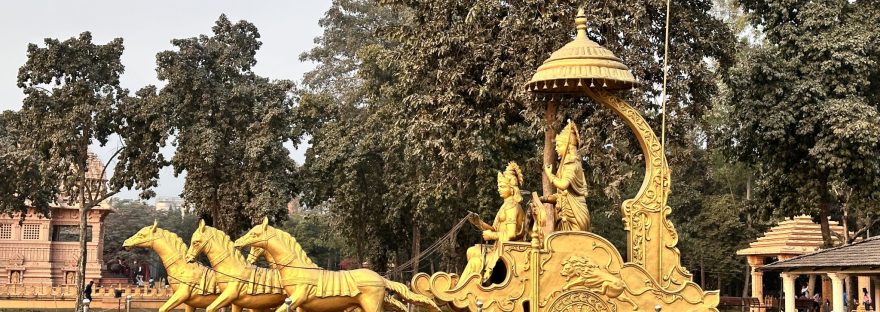
Wie die vedische Tradition vorschreibt, kann die Bitte eines brahman (Priester) nicht abgelehnt werden. Arjuna und Krishna erklären sich daraufhin bereit, die Hindernisse zu beseitigen, die der Tat, dem Verbrennen des Waldes, im Wege stehen, sagen aber, dass sie dazu einen Wagen und die nötigen Waffen benötigen. Und so werden ihnen die Waffen angeboten, die später im Kampf gegen die Kräfte eingesetzt werden, die den Weg zur Selbsterkenntnis unterdrücken.

Mit den Waffen aus der Episode mit Agni besiegen Arjuna und seine Armee unter der Führung Krishnas später die Unterdrückung durch den Tyrannen Duryodhana. Sobald der Krieg vorbei ist, wendet sich Krishna an Arjuna und bittet ihn, aus dem Wagen auszusteigen, der sie während des Krieges gefahren hat. Sobald er aus dem Streitwagen aussteigt, verschwindet es einfach.

Die Vedanta Lehrerin stellt dann eine schöne Parallele zum Leben her, die ich in meinen eigenen Worten und Überlegungen beschreibe:

Die Existenz von allem um uns herum hat eine Dauer, eine Gültigkeit. Alle Werkzeuge, die wir vom Leben erhalten, sind uns gegeben, um uns im Sinne des Selbststudiums und der Selbsterkenntnis zu dienen, mit Respekt und Sorgfalt für alles um uns herum. Unsere spirituelle Entwicklung hängt vom angemessenen Gebrauch dieser Werkzeuge ab, mit der richtigen Einstellung.

Und ich denke wieder an das Gleichnis vom Wolf. Welchen Wolf füttern wir mit den Ressourcen, die uns die Existenz bietet?

Und dann kommt das Ende der Überlegungen. Wenn jedes dieser Mittel, die uns angeboten wurden, seine Funktion erfüllt hat, sind sie dazu verdammt, zu verschwinden, wie der Wagen und die Waffen, die im Krieg gegen Duryodhana verwendet wurden. Wir können hier Parallelen zu Menschen, Gütern, Arbeitsplätzen usw. ziehen. Wie viele Dinge haben wir im Leben verloren? Wie war unsere Einstellung zum Verlust? Oft klammern wir uns an das, was wir einmal hatten, an das, was uns gegeben wurde, und wir bleiben in einer Idee, einer Erinnerung, einer Vergangenheit stecken. Wir erkennen nicht, dass das Leben das Kapitel dreht und dass es an der Zeit ist, sich mit anderen Dingen und Situationen zu verbinden.

*

PORTUGUÊS

UM GRANDE DESAFIO NO CAMINHO ESPIRITUAL…

A cultura védica está tão embebida de espiritualidade, que ela se revela no cotidiano, através das músicas, da literatura. A espiritualidade nos espreita em cada esquina, em meio ao cotidiano caótico e não sem conflitos que presenciamos na Índia. O épico clássico indiano Mahabharata é um grande exemplo disso. Nele vemos as polaridades que movem o ser humano. A determinação em seguir o caminho da auto investigação — daquilo que é necessário e correto ser feito para que possamos seguir no sentido do autoconhecimento – anda, lado a lado, com o seu oposto. Essas duas polaridades, com seus graus de intensidade, estão em nós e geram conflito interno e a nossa volta.

Não posso deixar de lembrar da parábola do lobo:

Nós temos dentro de nós dois lobos diferentes. Um deles representa propensões como apego, possessividade, raiva, inveja, ciúme, ganância, orgulho, ressentimento, medo, culpa, arrogância, mesquinhez e assim por diante. O outro representa o oposto. Qual dos lobos nós vamos alimentar é um grande desafio de aprendizado que a vida nos oferece.

Escutando áudios da professora de Vedanta brasileira Glória Arieira, que narra o Mahabharata lindamente, chegamos ao final do primeiro capítulo. Ele termina com o encontro do guerreiro Arjuna e do avatar Krishna com o sábio Agni, cuja tradução é fogo. E o final da sua narração traz um bonito ensinamento, que eu divido com vocês no final deste texto.

Agni diz que tem muita fome e que só eles podem saciar essa fome que ele sente. Eles se prontificam a dar a ele o alimento que precisa. Ele então revela que, o que de fato precisa é devorar toda a floresta Khandava, densa e escura, que eles veem diante de si. Como a natureza do fogo é aquecer, queimar, podemos entender o que significa o devorar a que Agni se refere.

Como a tradição védica determina, não se pode negar o pedido de um brahmane (sacerdote). Arjuna e Krishna então concordam em eliminar os obstáculos que impedem o feito, a queima da floresta, mas dizem que para isso precisam de um carro e das armas necessárias. E então, a eles são oferecidas as armas que depois serão usadas na luta contra as forças que oprimem o caminho rumo ao  autoconhecimento.

Usando as armas do episódio envolvendo Agni, Arjuna e seu exército, guiados por Krishna, vencem mais tarde a opressão do tirano Duryodhana na guerra de Kurukshetra. Assim que a guerra acaba, Krishna vira-se para Arjuna e pede para ele sair do carro que os conduziu durante a guerra. Assim que ele desce do carro, o mesmo simplesmente desaparece.

A professora faz então um bonito paralelo com a vida, que eu descrevo com minhas palavras e reflexões:

A existência de tudo o que há ao nosso redor tem uma duração, uma validade. Todas as ferramentas que recebemos da vida nos são ofertadas para nos servir no sentido do auto estudo e autoconhecimento, com respeito e cuidado a tudo o que nos cerca. A nossa evolução espiritual depende do uso apropriado dessas ferramentas, com a atitude apropriada.

E volto a pensar na parábola do lobo. Que lobo estamos alimentando com os recursos que nos são ofertados pela existência?

E então vem o desfecho da reflexão. Quando cada um desses recursos que nos foram ofertados cumprem a sua função, eles estão fadados a desaparecer, como o carro e as armas usados na guerra de Kurukshetra contra Duryodhana. Nós podemos fazer aqui um paralelo com pessoas, bens, emprego etc. Quantas coisas já não perdemos na vida? Qual foi a nossa atitude diante da perda? Muitas vezes, nós nos apegamos ao que um dia possuímos, que nos foi ofertado, e ficamos presos a uma ideia, uma memória, um passado. Não conseguimos perceber que a vida está virando o capítulo e que é hora de se ligar a outros objetos e situações.

*

ENGLISH

A GREAT CHALLENGE ON THE SPIRITUAL PATH…

Vedic culture is so steeped in spirituality that it reveals itself in everyday life, through music and literature. Spirituality lurks around every corner, in the midst of the chaotic daily life and not without conflict that we witness in India. The classic Indian epic Mahabharata is a great example of this. In it we see the polarities that drive human beings. The determination to follow the path of self-inquiry – of what is necessary and right to be done so that we can move towards self-knowledge – goes hand in hand with its opposite. These two polarities, with their degrees of intensity, are in us and generate conflict within and around us.

I can’t help but remember the parable of the wolf:

We have within us two different wolves. One represents propensities such as attachment, possessiveness, anger, envy, jealousy, greed, pride, resentment, fear, guilt, arrogance, pettiness and so on. The other represents the opposite. Which of the wolves we feed is a great learning challenge that life offers us.

Listening to audios by Brazilian Vedanta teacher Glória Arieira, who narrates the Mahabharata beautifully, we come to the end of the first chapter. It ends with the meeting of the warrior Arjuna and the avatar Krishna with the sage Agni, whose translation is fire. And the end of his narration brings a beautiful teaching, which I’ll share with you at the end of this text.

Agni says that he is very hungry and that only they can satisfy his hunger. They offer to give him the food he needs. He then reveals that what he really needs is to devour the entire dense, dark Khandava forest that they see before them. Since the nature of fire is to heat, to burn, we can understand what is meant by the devouring to which Agni refers.

As the Vedic tradition dictates, the request of a brahman (priest) cannot be denied. Arjuna and Krishna then agree to remove the obstacles preventing the deed, the burning of the forest, but say that to do so they need a chariot and the necessary weapons. And so, they are offered the weapons that will later be used in the fight against the forces that oppress the path towards self-knowledge.

Using the weapons from the episode involving Agni, Arjuna and his army, guided by Krishna, later defeat the oppression of the tyrant Duryodhana in the Kurukshetra war. As soon as the war is over, Krishna turns to Arjuna and asks him to get out of the car that drove them during the war. As soon as he gets out of the car, it simply disappears.

The teacher then makes a beautiful parallel with life, which I describe in my own words and reflections:

The existence of everything around us has a duration, a validity. All the tools we receive from life are offered to us to serve us in the sense of self-study and self-knowledge, with respect and care for everything around us. Our spiritual evolution depends on the appropriate use of these tools, with the appropriate attitude.

And I think again of the parable of the wolf. Which wolf are we feeding with the resources offered to us by existence?

And then comes the end of the reflection. When each of these resources that have been offered to us fulfills its function, they are doomed to disappear, like the car and the weapons used in Kurukshetra’s war against Duryodhana. We can draw a parallel here with people, goods, jobs, etc. How many things have we lost in our lives? What was our attitude towards loss? Often, we cling to what we once had, what was given to us, and we get stuck in an idea, a memory, a past. We fail to realize that life is turning the corner and that it’s time to connect with other objects and situations.

Allgemein

Take it easy, gehe in die Tiefe und lasse los!

(Versão em português abaixo) * (English version bellow)

Im letzten Text haben wir darüber gesprochen, wie ein intimer Blick auf den komplexen Körper und Geist uns helfen kann, unsere physischen, mentalen, emotionalen und energetischen Knoten zu visualisieren. Und wenn wir uns unsere Spannungen vergegenwärtigen, sind wir eingeladen, einen neuen Schritt zu tun – den Knoten zu lösen. Etwas Wesentliches auf dem Weg eines jeden Yoga-Praktizierenden, eines jeden Lebewesens, das nach dem viel erträumten Glück strebt, ist das Erlernen von Loslösung. Knoten (Spannungen) lösen, heißt loslassen.

Angesichts des Gedankens der Loslösung kann es jedoch zu Konflikten kommen. Wir sind uns sicher, dass wir glücklich sein wollen, aber wollen wir wirklich unsere Knoten lösen? Oft haben wir Angst, sie zu lösen, weil wir annehmen: „Dieser Knoten bin ich. Das ist es, was ich bin“. Wir identifizieren uns, wir verwechseln uns mit unseren Spannungen. Wie kann man ohne diesen oder jenen Schmerz leben? Wie kann man leben, ohne sich vor diesem oder jenem Unbehagen zu schützen?  Wir haben Angst, uns selbst nicht mehr zu erkennen, wenn sich ein Knoten löst. Wir haben Angst vor dem Neuen, vor der Veränderung. Denn wer bin ich schon ohne diese und jene Narbe?

Aus dem entstandenen Knoten wurden Gewohnheiten und Überlebensstrategien entwickelt, Anhaftungen und Abneigungen sind entstanden, Entscheidungen wurden getroffen. Das Lösen von Knoten stellt viele der Strukturen in Frage, die wir in uns und um uns herum geschaffen haben. Die Gefahr des Abbruchs „alter“ Denkweisen, Werte, Lebensweisen, des Selbstverständnisses ist alarmierend. Das Gefühl, mit einem Knoten konfrontiert zu sein, der gelöst werden muss, kann ein großer Widerstand sein. Schließlich steht offensichtlich viel auf dem Spiel.

Wir alle erleben oft komplizierte und schmerzhafte Situationen. Und wenn wir uns vornehmen, mit Leichtigkeit, Aufrichtigkeit und Mut tief in das einzudringen, was uns bedrückt, werden wir vielleicht überrascht sein, dass wir in Wirklichkeit gefangen, gefesselt und an das gebunden sind, was uns Unbehagen bereitet.

Ich habe einmal eine Erfahrung gemacht. Ich befand mich in einer schwierigen Situation, die mich traurig machte. Ich setzte mich zum Meditieren hin, schloss die Augen und schaffte es, mich ihr zu nähern – der Traurigkeit. Sie hatte etwas so Tiefgründiges! Sie tat weh, aber sie war auch so schön! Ich ging in ihr auf, konzentrierte mich, war in sie verliebt. Ich wurde von einer tiefen Vertrautheit mit diesem Gefühl überflutet. In meinem Kopf entstand dann ein Dialog. Eine Stimme sagte: „Gib mir diese Traurigkeit. Lege sie hier in meine Hand.“ Die Aufforderung hat mich erschreckt. Ich war so sehr damit beschäftigt. Ein Gefühl des Widerstands überkam mich. Ich habe sofort reagiert: „Nein, ich gebe sie nicht her. Sie gehört mir.“ Als ich diesen Dialog in meinem Kopf beobachtete, sah ich, wie sehr ich an diesem Gefühl hing. Und die Visualisierung der Verbundenheit half mir, mich von dieser Traurigkeit zu verabschieden. Ich habe beobachtet, was mich traurig gemacht hat. Mit der Zeit konnte ich verkraften und akzeptieren, wie die Dinge passiert sind, ich habe etwas aus dieser Erfahrung gelernt. Es gab keine ungelöste Situation mehr in der Warteschlange, was meinen Geist für die nächsten Erfahrungen frei machte.

Nichts sollte anders sein

Diese Erfahrung hat mich wirklich viel über Anhaftung und Loslösung gelehrt. Sie zeigte mir, dass ich an einer Idee festhielt; an der Art und Weise, wie ich denke, dass die Dinge sein sollten oder nicht sein sollten; an dem Wunsch, dass die Menschen anders gehandelt hätten… Und das ist die eigentliche Ursache der Schmerzen.

Anhaftung hat mit dem Mangel an Leichtigkeit (Flexibilität) zu tun, um die Welt so zu akzeptieren, wie sie sich darstellt. Akzeptanz bedeutet, das Leben so zu nehmen, wie es ist, und nicht zu versuchen, es mit Kraft so zu gestalten, wie es meiner Meinung nach hätte sein sollen oder sein muss. Nichtakzeptanz ist der Versuch, Situationen zu entkommen, wie sie sich darstellen, und raubt uns die Ruhe und Energie, um mit den Tatsachen bestmöglich umzugehen. Das Mantra, das ich seither zu vibrieren versuche, lautet: „Nichts sollte anders sein, als es ist. Alles ist genau so, wie es sein soll.“ Nichts muss anders sein als das, was ist, damit ich mich selbst und die Welt um mich herum (Situationen, Menschen usw.) gut fühlen kann.

Yoga lehrt mich, mich in Zufriedenheit zu üben (die aus der Akzeptanz erwächst), selbst wenn mich etwas verletzt. Ich fühle eine tiefe Wärme und ein Willkommensgefühl, wenn ich in mich selbst eintauche und alles sehe, was vor sich geht, auch wenn etwas nicht so geschieht, wie ich es mir wünsche. Ich freue mich, wenn ich aus dem Geschehenen, aus dem Unerwarteten etwas Neues lernen kann. Und das größte Vergnügen von allen ist die Leichtigkeit, nicht mehr so viele ungelöste Situationen im Gepäck zu haben, wenn ich durchs Leben gehe. Dadurch wird die Zahl der ungelösten Fälle in der Warteschlange verringert! Loslösung und Akzeptanz machen mein Gepäck leichter. Und all dies erfüllt mich mit tiefer Dankbarkeit. Die Dankbarkeit, dass ich mich selbst entdecken (sehen) kann. Es ermöglicht mir, die Schönheit auch dort wahrzunehmen, wo sie nicht zu wohnen scheint.

*

PEGA LEVE, VAI FUNDO E DESAPEGA!

No último texto, falamos como o olhar íntimo sobre o complexo corpo e mente pode nos ajudar a visualizar nossos nós físicos, mentais, emocionais, energéticos. E uma vez visualizada as nossas tensões, somos convidados a dar um novo passo – desfazer o nó. Algo essencial no percurso de todo e qualquer praticante de yoga, de todo e qualquer ser vivente que busca a tão sonhada felicidade é o aprendizado do desapego. Desatar nós, tensões é desapegar-se.

Porém, diante da ideia do desapego, podem surgir conflitos. Nós temos certeza que queremos ser felizes, mas será que queremos mesmo desatar os nossos nós? Muitas vezes, temos medo de desfazê-los, porque supomos: “esse nó sou eu. Eu sou assim mesmo.” Nós nos identificamos, nos confundimos com as nossas tensões. Como viver sem essa e aquela dor? Como viver sem se proteger desse ou daquele incomodo?  Temos medo de não mais nos reconhecermos quando um nó for desatado. Temos medo do novo, da mudança. Quem sou eu afinal sem essa e aquela cicatrizes?

A partir do nó criado foram desenvolvidos hábitos, estratégias de sobrevivência, criados apegos e aversões, tomadas decisões. O desatar de nós coloca em xeque muito da estrutura que criamos em nós e em torno de nós. O alarme do perigo da demolição de “antigas” formas de pensar, valores, formas de viver, a forma como cada um se vê é soado. A sensação, ao se deparar com um nó que precisa ser desatado, pode ser de grande resistência. Afinal, aparentemente, há muita coisa em jogo.

Nós todos passamos por situações muitas vezes complicadas e dolorosas na vida. E se nos propusermos um exercício íntimo de ir fundo, com leveza, com sinceridade, com coragem naquilo que nos aflige, podemos nos surpreender com o fato de que estamos de fato presos, atados, apegados àquilo que nos causa incomodo.

Uma vez tive uma vivência. Estava passando por uma situação difícil e que me causava tristeza. Eu sentei para meditar, fechei os olhos e consegui me aproximar dela – a Tristeza. Ela tinha algo tão profundo! Ela doía, mas era também tão bela! Eu fiquei absorvida, focada, enamorada dela. Fui inundada por uma profunda intimidade com aquele sentimento. Na minha mente apareceu então um diálogo. Uma voz disse – “Me dá aqui essa tristeza. Coloca ela aqui em minha mão.” Eu me assustei com o pedido. Eu estava tão envolvida com ela. Uma sensação de resistência me tomou. Imediatamente, reagi: “não, não dou. Ela é minha.” Ao observar esse diálogo em minha mente, eu vi o tamanho de meu apego àquele sentimento. E o fato de visualizar o apego, me ajudou a me flexibilizar para me despedir daquela tristeza. Eu observei o que me causou tristeza, consegui digerir e aceitar como as coisas ocorreram, aprendi algo com aquela experiência. A minha mente ficou então livre daquela situação específica para as próximas vivências e aprendizados.

Nada deveria ser diferente

Essa vivência me ensinou de fato muito sobre o apego e o desapego. Me mostrou que eu estava me segurando firme a uma ideia, à forma como eu acho que as coisas deveriam ser ou deixar de ser, ao desejo de que as pessoas tivessem agido diferente. E é isso que de fato causa a dor.

O apego tem a ver com a falta de leveza, de flexibilidade para aceitar o mundo como ele se apresenta e partir para a próxima experiência. Aceitação é fluir com a vida como ela é, não tentar usar a força bruta para moldá-la da forma como eu acho que deveria ter sido ou deveria ser. A não aceitação é a tentativa de fuga das situações como elas se apresentam e rouba a nossa paz e energia para lidar da melhor forma com os fatos. O mantra que procuro entoar desde então é: “nada deveria ser diferente do que é. Tudo é exatamente como deve ser.” Nada precisa ser diferente do que é, para que eu possa me sentir bem comigo mesma e com o mundo ao meu redor (situações, pessoas etc).

O Yoga tem me ensinado a praticar o contentamento (que transborda da aceitação) até mesmo quando algo me machuca. Eu sinto um profundo calor ao mergulhar em mim e ver tudo o que se passa no meu íntimo quando algo não acontece como eu gostaria. Eu sinto prazer em aprender algo novo com o ocorrido, com o inesperado. E o maior prazer de todos é a leveza de não ter que carregar mais tantas situações mal resolvidas na minha bagagem, enquanto eu transito pela vida. O desapego, a aceitação vão deixando a minha bagagem mais leve. E tudo isso vai me inundando de gratidão. A gratidão de poder me ver, de poder me descobrir. Eu vou vendo beleza até onde ela aparentemente não habita.

*

TAKE IT EASY, GO DEEP AND LET GO!

In the last text we talked about how an intimate look at the complex body and mind can help us visualize our physical, mental, emotional, energetic knots. And once we visualize our tensions, we are invited to take a new step – to undo the knot. Something essential in the path of each and every yoga practitioner, of each and every living being who seeks the much dreamed happiness is the learning of detachment. To untie knots, tensions, is to let go.

However, in the face of the idea of detachment, conflicts may arise. We are sure that we want to be happy, but do we really want to untie our knots? Often, we are afraid to undo them, because we assume, „that knot is me. That’s just who I am.“ We identify ourselves, we confuse ourselves with our tensions. How to live without this and that pain? How to live without protecting myself from this or that discomfort?  We are afraid that we will no longer recognize ourselves when a knot is untied. We are afraid of the new, of change. After all, who am I without this and that scar?

From the knot created, habits and survival strategies were developed, attachments and aversions were created, decisions were made. The untying of knots calls into question much of the structure we have created in and around ourselves. The alarm of the danger of the demolition of „old“ ways of thinking, values, ways of living, the way one sees oneself is sounded. The feeling, when faced with a knot that needs to be untied, can be one of great resistance. After all, there is apparently a lot at stake.

We all go through often complicated and painful situations in life. And if we propose an intimate exercise of going deep, with lightness, with sincerity, with courage, into what ails us, we may be surprised by the fact that we are in fact stuck, tied, attached to what bothers us.

I once had an experience. I was going through a difficult situation that was causing me sadness. I sat down to meditate, closed my eyes and was able to approach it – the Sadness. It had something so deep! It hurt, but it was also so beautiful! I became absorbed, focused, enamored with it. I was flooded with a deep intimacy with that feeling. In my mind a dialogue then appeared. A voice said – „Give me this sadness. Put it here in my hand.“ I was startled by the request. I was so involved with it. A feeling of resistance came over me. Immediately, I reacted, „No, I won’t. It is mine.“ As I observed this dialogue in my mind, I saw how deep was my attachment to that feeling. And visualizing the attachment, helped me to flex myself to say goodbye to it. I observed what caused me sadness, I was able to digest and accept how things occurred, I learned something from that experience. My mind was then free of that particular situation for the next experiences and learning.

Nothing should be different

This experience really taught me a lot about attachment and detachment. It showed me that I was holding on tightly to an idea, to the way I think things should be or should not be, to the wish that people had acted differently. And that’s what actually causes the pain.

Attachment has to do with a lack of lightness, a lack of flexibility to accept the world as it is and move on to the next experience. Acceptance is about flowing with life as it is, not trying to use brute force to shape it the way I think it should have been or should be. Non-acceptance is trying to escape from situations as they present themselves and steals our peace and energy to best deal with the facts. The mantra I have tried to chant since then is, „nothing should be different than it is. Everything is exactly as it should be.“ Nothing needs to be different than it is, so that I can feel good about myself and the world around me (situations, people etc).

Yoga has taught me to practice contentment (which overflows from acceptance and detachment ) even when something hurts me. I feel a deep warmth to dive into myself and see all that is going on inside me when something doesn’t turn out the way I would like. I take pleasure in learning something new from what has happened, from the unexpected. And the greatest pleasure of all is the lightness of not having to carry so many unresolved situations in my luggage as I go through life. Detachment and acceptance make my baggage lighter. And all this is flooding me with gratitude. The gratitude for being able to see myself, to discover myself. I go on seeing beauty even where it apparently doesn’t exist.